
How to Check for a Warrant in Dillon
Begin with the department or court connected to the paperwork. Dillon Police does not publish a public warrant search, so for a municipal citation call Dillon Municipal Court with the citation number or court date. For a county or General Sessions matter, contact the court listed on the notice. Have the name, date of birth, case or ticket number, and any payment receipt ready; the clerk can explain what it can confirm.
- Check the Dillon Police Department’s official page for contact information; it does not provide a public warrant list.
- For a city citation, contact Dillon Municipal Court and identify the ticket or case number.
- Ask the court clerk whether the record shows a warrant, appearance, balance, or another required step.
- For a county matter, use the Dillon County Sheriff or the specific issuing court; county offices handle separate records.
- South Carolina has no comprehensive public warrant search identified in this research. Consult an attorney about resolving a confirmed warrant.
Dillon Police Does Not Publish a Warrant Roster
The city police page provides a department contact, but the research found no online warrant lookup or public Dillon wanted-person list there. Call the department only for law-enforcement routing. Questions about whether a judge issued or recalled process belong with the court that controls the case. The Sheriff’s county directory is also separate from Dillon Police.
The Dillon Police Department page is the official city source for its police office.
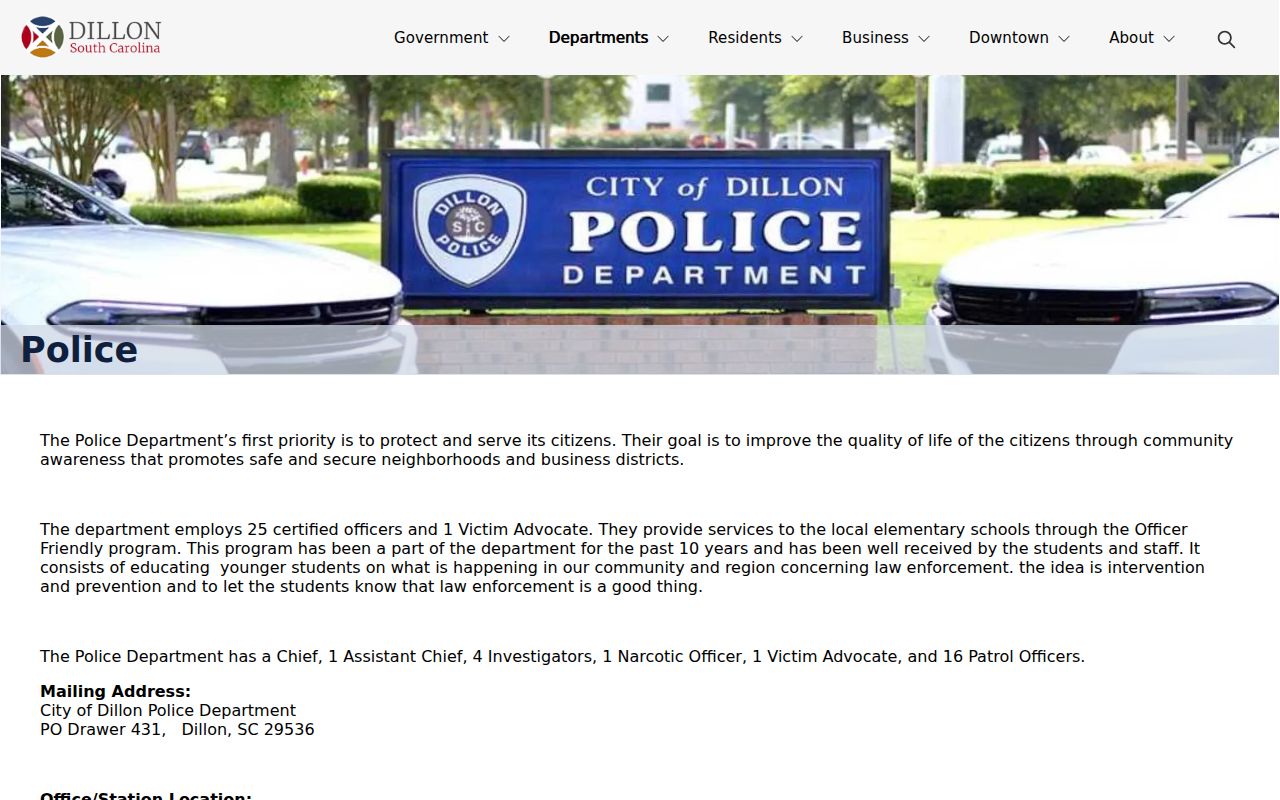
This directory image does not show a warrant roster or a live case record.
The Dillon Police Department and Municipal Court
Dillon Police and Dillon Municipal Court are separate city offices. The court handles city cases and its judge controls court process; police perform law-enforcement duties. The municipal court is listed at 401 W Main Street and handles local traffic, ordinance, and qualifying misdemeanor matters. A police contact cannot substitute for a court disposition or recall decision.
The court lists (843) 774-0049, extension 1019, for its clerk. The city police page is an agency directory, not a warrant search. If you are unsure whether the matter is municipal or county, read the court name on the notice before calling.
Dillon Warrant Calendar Separates Bond and Trial Dates
Dillon Municipal Court lists bond sessions at 8 a.m. and 1 p.m. daily at the Detention Center, while its regular court session is Wednesday at 9 a.m. These are different calendar events. A reader should ask which event applies to the particular case before traveling and should not assume that a bond session is a walk-in warrant clearance window.
The official Dillon Municipal Court page is the source for its published schedule and contact information.
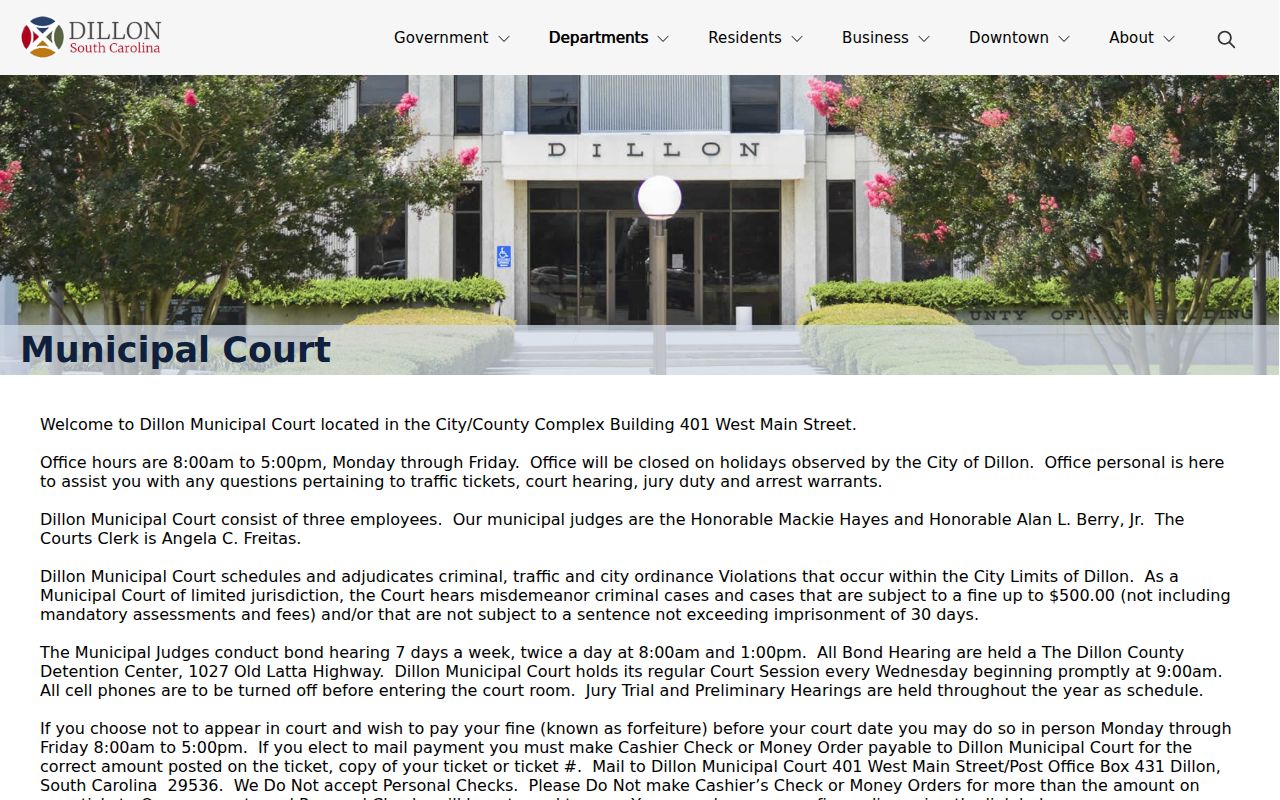
Confirm the next appearance and required documents with the court before going to the listed location.
Types of Dillon Warrants
A Dillon resident may have a city-court issue or a case outside the city’s jurisdiction. A traffic citation, an order after a missed appearance, and an arrest warrant are different records. The correct court depends on the alleged matter and issuing document, not simply the person’s residence.
| Warrant Type | How It Arises | Who Issues It |
|---|---|---|
| Traffic warrant | Court action after an unresolved Dillon traffic citation or missed date | Dillon Municipal Court when issued there |
| Ordinance process | Unresolved matter under a city ordinance | Dillon Municipal Court |
| FTA / city bench warrant | Missed Dillon Municipal Court setting | Municipal judge |
| Arrest warrant | Judicial process in a criminal investigation | Issuing Magistrate or other court |
Dillon Traffic Warrant Payments May Need a Compliance Notice
Dillon Municipal Court states that a payment made more than 15 days after a ticket requires a Notice of Compliance to be filed with the South Carolina Department of Motor Vehicles. That notice is part of the city’s traffic process and should be kept with the payment receipt. It does not confirm that a separate warrant or missed-appearance issue has been resolved.
Ask the clerk who must submit the notice and whether the court still expects an appearance. Confirm any license status with SCDMV separately. Do not apply this city rule to citations issued by Latta, Lake View, or another court.
What a Dillon Warrant Record Shows
No local public example establishes a standard Dillon warrant format. When you speak with a clerk, confirm court and case identifiers before relying on a matching name. A case-index entry may not display the complete warrant or its current service status.
| Warrant / Cause Number | Use the number on the notice; Dillon’s local format is not published. |
|---|---|
| Subject Name | Compare the full name and other court identifiers; a name alone may match another person. |
| Charge / Offense | Read the filed charge or city ordinance and confirm it with the court. |
| Issuing Court | Dillon Municipal Court, Magistrate Court, or the court named on the record. |
| Bond / Fine Amount | Ask the issuing court for the current amount and terms. |
| Status | Ask whether the court shows active, recalled, served, or another disposition. |
Dillon Warrant Records in the Public Index Need a Clerk Check
The statewide Public Index can help locate participating court cases, but it is not a live warrant dashboard. A search result may lack the full signed document, current service status, or later docket action. A missing result may reflect search criteria, case age, confidentiality, or the fact that another court holds the case.
Use the court name, case number, and filed charge to identify the record, then ask Dillon Municipal Court whether its docket shows active process. Do not treat a third-party name match as proof that the record belongs to you.
Where Dillon Warrants Fit With Dillon County
Dillon Municipal Court and Police handle city records; the Dillon County Sheriff handles county law-enforcement work. South Carolina does not offer a comprehensive public warrant system identified by this research. A city matter may require a separate county inquiry if another court is involved.
Warrant flow: Dillon Municipal Court / Police › Dillon County Sheriff › issuing court confirmation
For county process, see Dillon County warrant records and the county warrant search guidance. This city route covers Dillon matters only.
Dillon Warrant Cases Stay Distinct From County Cases
Dillon Police may make an arrest or serve process, but county detention and the court system can enter different stages after that event. The county Sheriff page does not publish a city warrant roster. If a person is in custody, detention staff can explain booking and facility routing; questions about bond or recall still belong with the judge or attorney handling the case.
Keep city and county case numbers separate. If two offices give different answers, ask each to identify the docket it searched and the date of its information.
Public Access to Dillon Warrant Records
South Carolina law provides a process to request covered government records, but an open-records law does not make every court record public. Case access may depend on the record type, court rules, and statutory exceptions. Juvenile matters and sealed material require particular care; ask the clerk what may be inspected or requested.
Key Rules:
South Carolina Freedom of Information Act, S.C. Code § 30-4-30 - permits inspection or copying of covered public-body records within reasonable access rules.
S.C. Code § 30-4-40 - sets out statutory exceptions that can limit disclosure.
S.C. Code Title 63, Chapter 19 - limits disclosure of specified juvenile records and identifying information.
Dillon City Record Requests Need the Right Custodian
A request for a Dillon city record should be directed to the city office that created or maintains it. County FOIA contact instructions apply to county records, not automatically to a city police or municipal-court file. The clerk can explain inspection procedures and whether a request must identify a date range or case number. Access may be limited by law, court rule, or an active investigation.
Use the Freedom of Information Act for eligible government records, but do not expect it to create a new search service or expose sealed information. Juvenile records are subject to separate confidentiality protections.