
Arrest Warrants in Dillon County
An arrest warrant in South Carolina is written charging process built on probable cause. It does not start with paperwork alone. The state's Summary Court Benchbook lays out the sequence: a sworn complaint first, then a review by a magistrate or municipal judge sitting where that court has authority. The judge's signature and order are what matter. A complaint sitting in a file, or a blank form, proves nothing about whether a warrant issued. In Dillon County, law enforcement or another authorized complainant starts the process, and the reviewing judge weighs whether the legal basis holds. The court and the Clerk of Court then manage the warrant record and related papers. Which route applies depends on the charge and the court's jurisdiction, so the office named in the paperwork is the best first call.
Dillon County Arrest Warrants Start With Probable Cause
State law sets the framework. S.C. Code §22-5-110 governs arrest-warrant issuance and certain courtesy-summons procedures, and it covers situations where a later failure to appear can trigger further process. A summons, though, is not automatically an arrest warrant. The South Carolina statute and the Judicial Branch Summary Court Benchbook walk through the statewide steps. A judge weighs the request against the law and the facts presented. So do not read issuance into an open investigation or a blank form. In Dillon, a Magistrate or municipal judge handles matters within summary-court authority, while serious General Sessions cases follow a separate Circuit Court and solicitor path.
Process note: Probable-cause review is a judicial step. A law-enforcement request is not itself a signed warrant.
What a Dillon County Arrest Warrant Contains
South Carolina's blank bench-warrant forms show a statewide template, not a filled-in Dillon County warrant. Expect fields for a warrant number, issue date, court, and the charge or appearance context. A judge's signature, service certification, and officer return may follow. Sensitive identifiers and physical-description fields are common on these forms as well.
| Warrant number | Identifier field on the state form; Dillon’s numbering format was not published. |
|---|---|
| Court and county | Shows which judicial office issued the process. |
| Charge or context | Names the offense or court appearance reason. |
| Judge and date | Signature and issue date fields record judicial action. |
| Service return | Officer, date, and return fields document what happened after issuance. |
| Sensitive fields | Blank forms contain personal identifiers; do not reproduce a filled record. |
Dillon County Arrest Warrant Papers Go to Clerk
Paperwork has a home in Dillon County. Criminal warrants land with the Clerk of Court, who passes them along to the solicitor. Rule 3 of the South Carolina Rules of Criminal Procedure governs sending arrest-warrant, bond, and related papers to the Clerk of General Sessions. The Clerk keeps the court file and the docket. That job does not reach the judge's call on whether to issue or recall process. Reach the office at (843) 774-1425 or 301 W Main Street. The Clerk of Court page lists the address, the phone, the criminal-record role, and the office's warrant and docket duties. If your file sits in General Sessions, ask which Dillon County office handles the next procedural question. Keep in mind that a case-index row is not a complete warrant document.
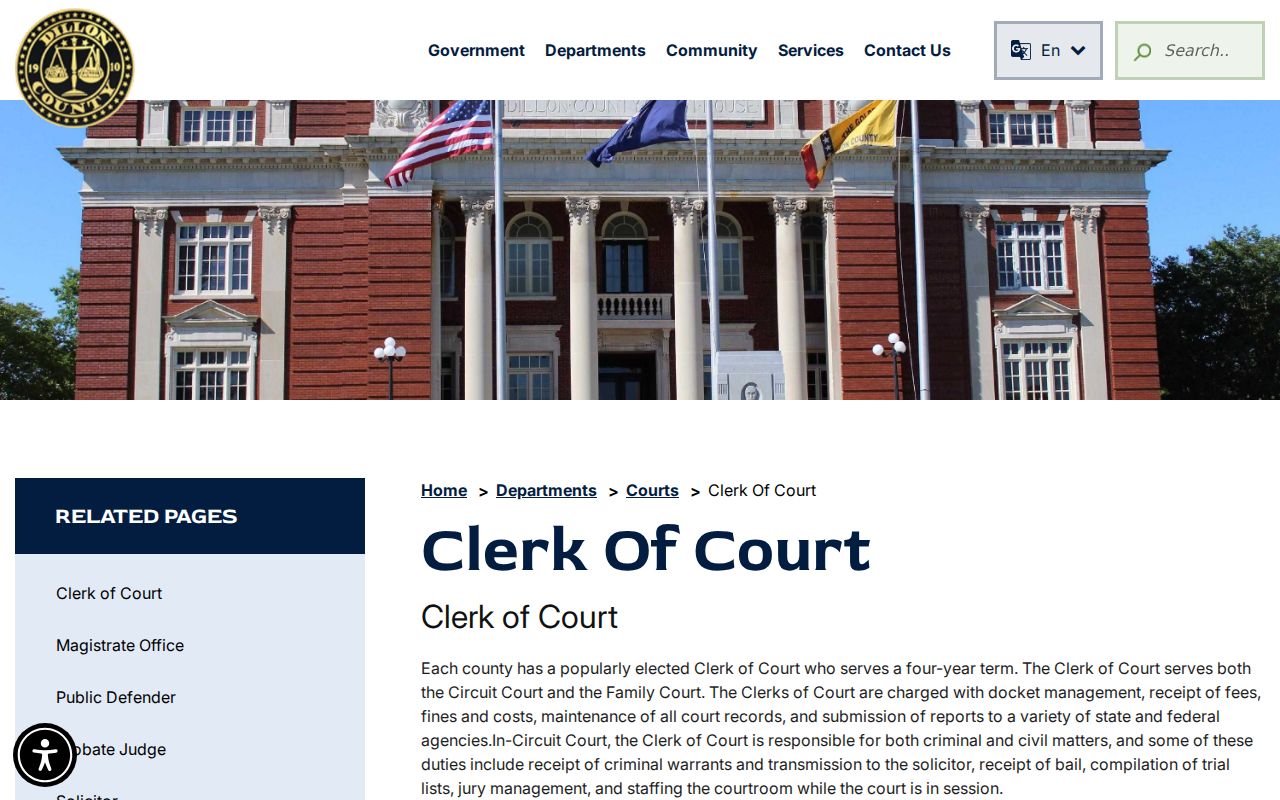
The image identifies the court-administration contact, not a live case record.
How Arrest Warrants Are Served
Serving a warrant is its own job in Dillon County. The Sheriff's page describes law-enforcement and custody duties but names no warrant unit and posts no service roster. City police are a separate agency. Municipal judges issue city-court process inside their own jurisdiction. Which office serves a Dillon County warrant depends on the court and the case, so do not assume every outstanding warrant sits with the Sheriff or city police. After an arrest, the proper court sets the bond or the next appearance. The Clerk, the solicitor, an attorney or public defender, the sheriff, and detention staff each handle a different task. A bond decision does not close the underlying criminal case. Ask the court what paperwork is required and what event comes next.
Dillon County Arrest Warrants Have Separate Serving Roles
The court issues the process; an authorized officer serves it. General Sessions papers move through the Clerk and solicitor. Magistrate matters go through the summary court. Dillon Municipal Court handles city traffic, ordinance, and qualifying misdemeanor cases, while Dillon Police and the county Sheriff remain distinct agencies.
The Fourth Circuit Solicitor page explains bond, preliminary-hearing, grand-jury, and transfer-court steps. It does not provide a warrant search. Ask which court has the case before calling the agency expected to serve process.
The Solicitor’s page places General Sessions process in its local court context.
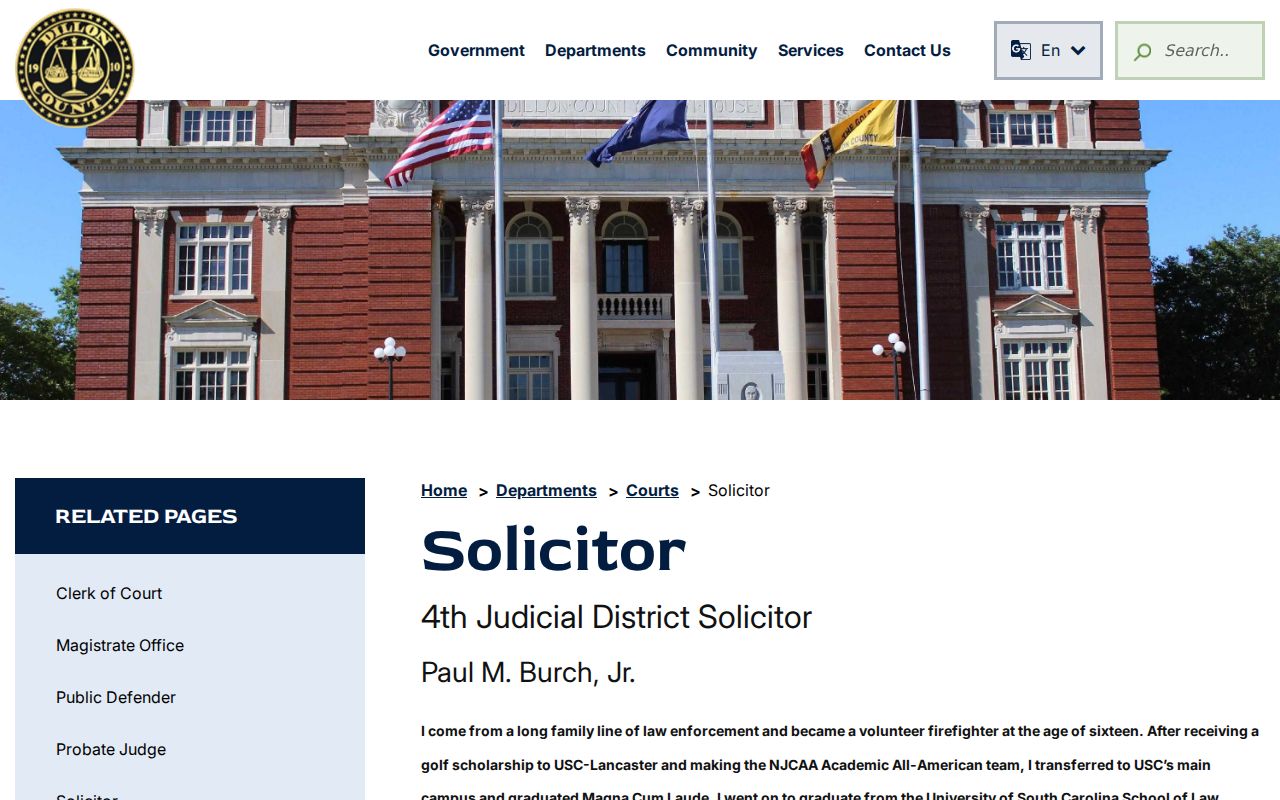
Bond guidance for a Dillon County warrant explains one court step; it is never a fixed amount for every warrant.
Arrest Warrant vs Summons vs Bench Warrant
South Carolina draws real lines here. An arrest warrant authorizes an arrest after a probable-cause review. A courtesy summons or traffic ticket simply directs a person to respond or appear. A bench warrant is court process tied to a missed appearance or another obligation in an existing case. See the Dillon County bench-warrant explanation for that separate route.
| Feature | Arrest Warrant | Summons | Bench Warrant |
|---|---|---|---|
| What it does | Authorizes arrest under the signed order | Directs a person to appear or respond | Brings a person before the court on an existing matter |
| Basis | Probable-cause charging process | Process allowed by the court or applicable law | Failure to appear or comply, as the judge determines |
| Who controls it | Issuing judge and authorized serving agency | Court named on the summons or ticket | Judge of the court with the case |
| Next question | Ask court or counsel about status, appearance, and bond | Confirm date and response instructions | Ask issuing court about reset, hearing, or recall |
Federal Dillon County Warrants Stay Separate
A federal arrest warrant is not searched through the Dillon Public Index, county Clerk, or city court. Dillon County lies within the U.S. District Court for the District of South Carolina, with the Florence courthouse serving the region. PACER may show public docket items, but sealed warrants may not appear. Use the federal Clerk, counsel, or official U.S. Marshals route for a federal notice.
The Florence federal courthouse page gives the official venue reference. A federal docket search is not a county warrant confirmation. Keep a federal case number and court name separate from a Dillon state case.
The official Florence court page identifies the federal venue for this region.
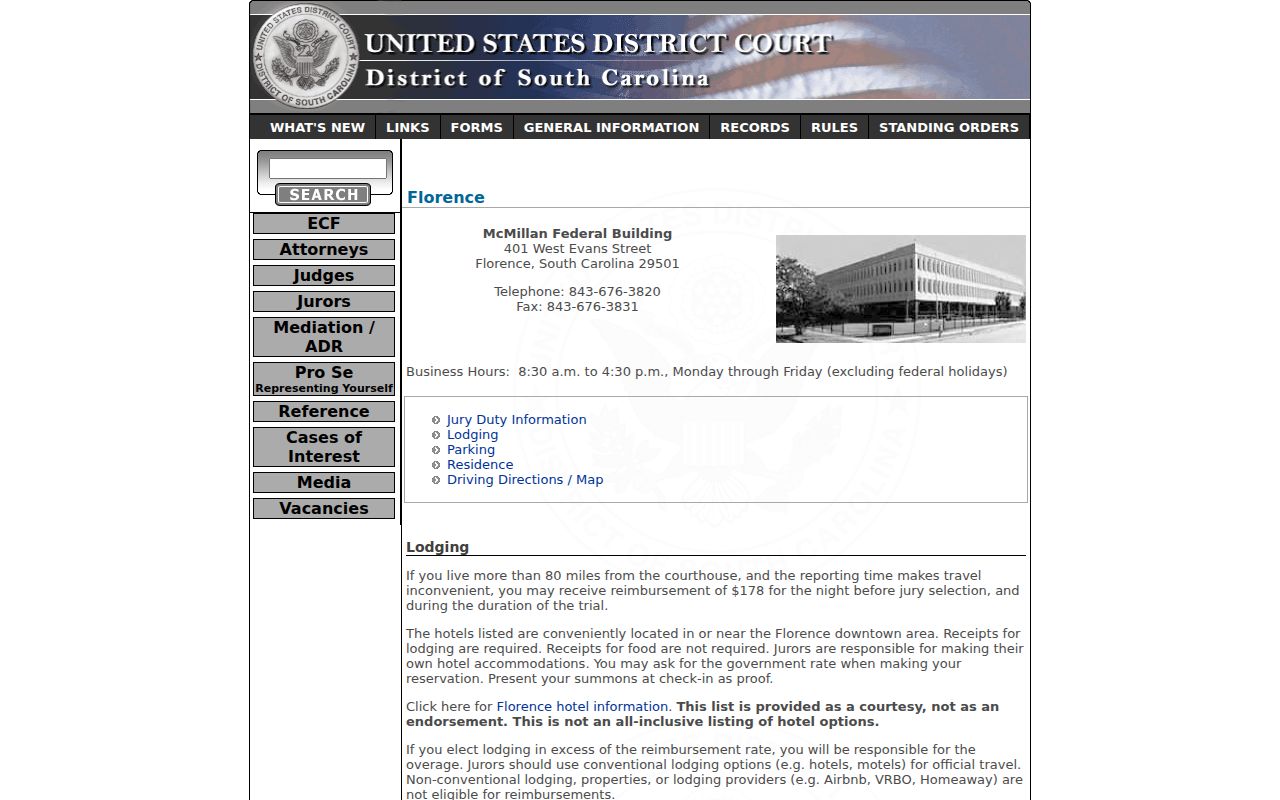
The Dillon County federal courthouse contact route covers where to call, but it posts no list of people or outstanding warrants.
Dillon County Arrest Warrant Surrender Needs Confirmation
Once a Dillon County court confirms an active warrant, the smart move is to slow down and ask questions before walking in. Should counsel arrange the appearance? Where do you report, which papers and identification should you bring, and which bond calendar governs your case? No Dillon source publishes one walk-in surrender spot or a single window of hours that fits everyone, so those details have to come from the court itself. Someone already in custody can ask detention staff about routing by calling (843) 841-3730, though those staff have no power over a judicial recall. If the Fourth Circuit Public Defender represents you in General Sessions, that attorney is the person to call, especially after a missed date. Keep every document you collect, from bond papers and receipts to any order or Notice of Compliance, and then ask the court what still remains open on the warrant and the case behind it.
What to Do If There Is a Warrant for You
Start by confirming which court issued the process and what kind it is. A General Sessions warrant belongs with the Clerk or your counsel. A Magistrate or municipal case means calling that specific Dillon County court directly. Ask whether a hearing, bond, or motion is required, and whether a documented excuse or other record should go into the file, because only the issuing court can recall, modify, or continue its own warrant. Posting bond settles custody conditions, not the charge itself, and a summons or a traffic citation carries its own response rules. Get the next court date in writing. Ask which office confirms each step along the way, and treat no criminal-history result, payment screen, or case-index row as the final word on a Dillon County warrant.
Important: Before going to the Sheriff, Detention Center, or courthouse, confirm the location and appearance instructions with the issuing court or counsel.